Overview
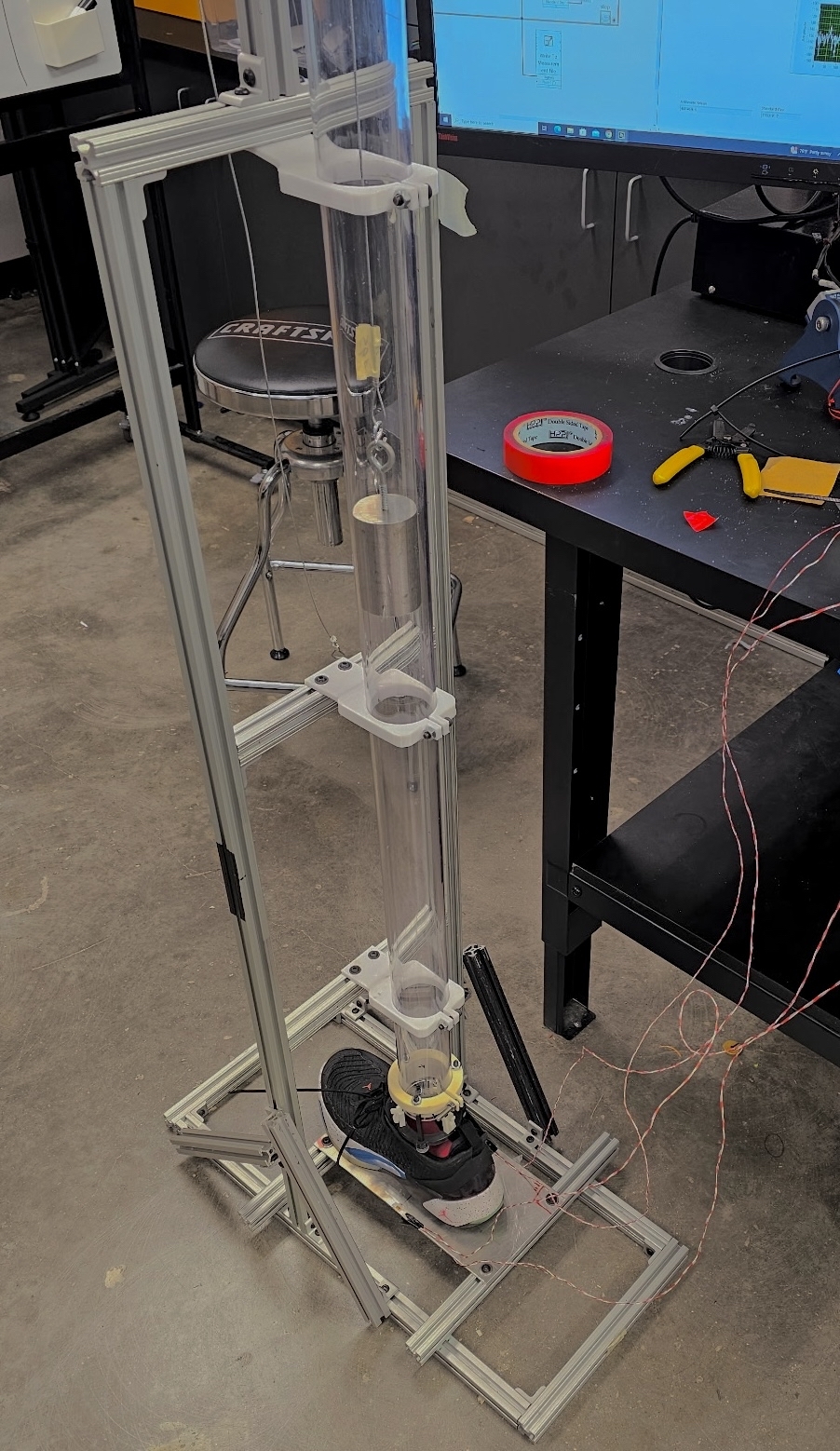
This was my final project for Electromechanical systems. My team designed and tested a method to gauge the effectivness of energy dissipation. In this lab, we investigated the force attenuation performance of three footwear types — Converse shoes, walking sneakers, and basketball shoes — using controlled drop tests on a custom-calibrated force plate. By analyzing force–time responses and impulse across multiple impact energies, we aimed to determine how shoe design influences peak loading and energy dissipation, and which configurations are most effective at reducing injury-relevant forces.
Design & Process
Our final project gaves us the freedom to choose something to research using software and sensors we've used in class. We chose to
utilize strain gauges as they are widely used in structural analysis.
Four gauges were arranged in a wheatestone bridge configuration to maximize the sensitivity of the sensors.
An aluminum plate was used for its ease of machining and rigidity for the scope of tests we performed.
Results
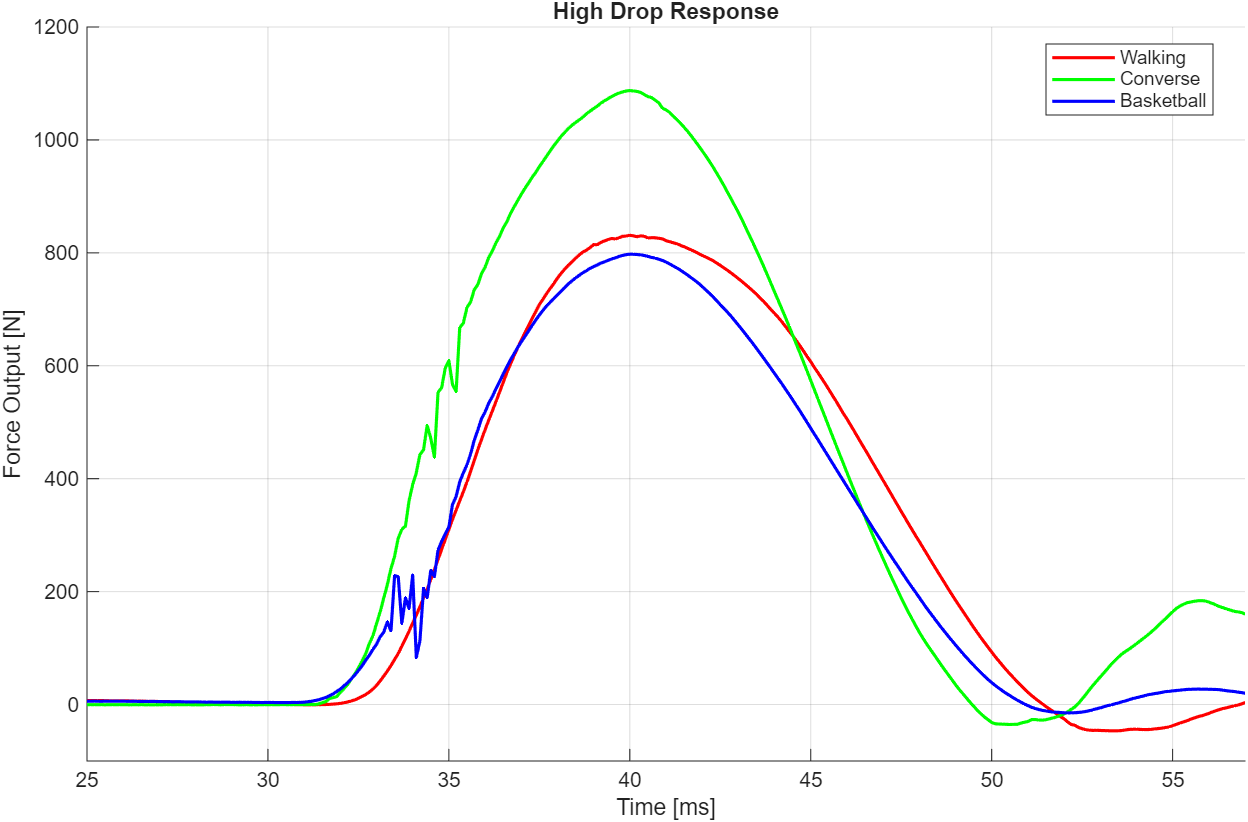
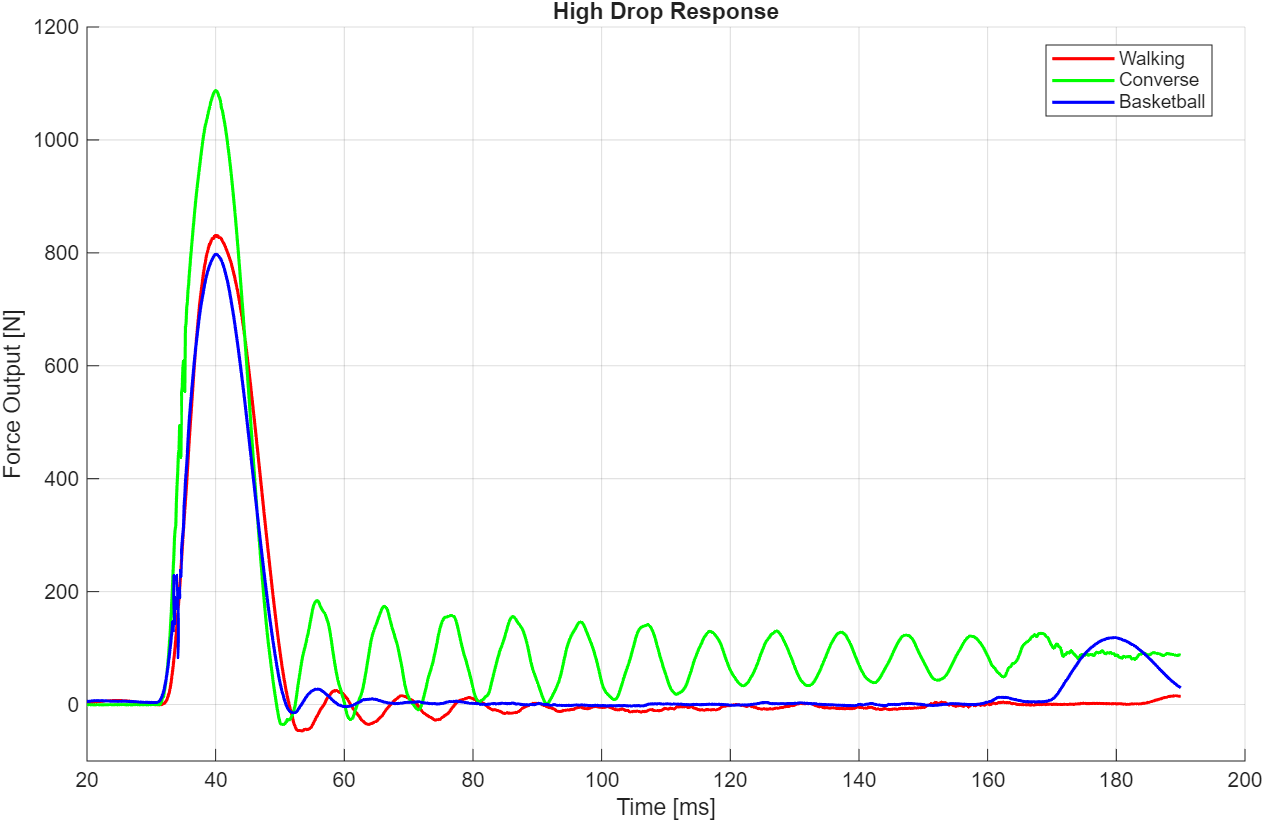
The experimental results demonstrated a clear relationship between footwear design and impact attenuation. Across all three drop energies, the Converse shoe consistently produced the highest peak forces and largest impulse values, indicating minimal energy dissipation and a strong reliance on the underlying structure to absorb impact. As the drop energy increased, this behavior became more pronounced, with larger force spikes and longer-lasting oscillations observed in the force–time response.
In contrast, both the walking sneakers and basketball shoes significantly reduced peak force and impulse across all trials. At the highest drop energy, the basketball shoes exhibited the greatest damping performance, aligning with their design intent for high-impact athletic use. Impulse measurements reinforced these findings, showing that increased cushioning reduced the magnitude of transmitted loads. Transient response data further highlighted these differences, as the more cushioned shoes dissipated energy quickly while the Converse shoe caused the aluminum plate to oscillate, ultimately leading to permanent deformation during the highest-energy test.
Reflection
This project provided valuable insight into the practical challenges of experimental testing and sensor-based measurement. Designing and calibrating a force plate using strain gauges required careful consideration of sensor placement, bridge configuration, and data acquisition settings to accurately capture rapid transient events. The calibration process and uncertainty propagation emphasized the importance of quantifying error when translating voltage measurements into meaningful physical quantities.
Beyond the technical results, this lab reinforced how engineering design decisions directly influence real-world performance and safety. Observing permanent deformation of the force plate during testing highlighted the consequences of insufficient energy dissipation and validated the importance of cushioning in injury prevention. Overall, this project strengthened my understanding of experimental mechanics, data interpretation, and the role of design intent in engineering solutions.